Sunday, 31 October 2010

Heinz Ploughman's Pickle: A Test Drive

In 1826 James Sharp purchased 200 acres of land that he found especially beautiful in order to build a log cabin for his wife there. The place came to be known as Sharpsburg and in 1869 the H.J. Heinz Company was founded there. Their first product was a horesradish condiment. By 1892 they had more than sixty products; however, as the number 5 had special significance to Henry John Heinz and 7 had special significance to his wife, the firm started using the slogan "57 varieties".


We recently took their "Ploughman's Pickle" for a test drive through a series of narrow country vegetables with some exhilirating stretches of muffin. Finally to fully assess it's performance we tried it out on a handraised pork pie and a slice of mozarella.

The handling was very responsive despite the pickle being mass-produced. The flavour did perhaps lack the oomph of more high-performance pickles but that is reflected in the price tag.

Finally a number of our readers have asked us to give a rating the various produce we review in this pages. We wouldn't wanted to lower ourselves to the vulgarity of a simple linear 1 to 10 scale but in order to assist our readers we will be asigning a shape to give a sense of how we perceived the experience. In order to help our readers benchmark this accurately we will also give a colour to indicate our mood at the time. We always welcome these interesting pieces of feedback from readers.

Mood: Sea mist billowing to autumunal greens and oranges.
Experience: Rhombus with a slightly drooping point.

Tuesday, 19 October 2010

The White Horse, Newburgh Street, Soho


The White Horse is a musical about the head waiter of an Austrain inn who falls hoplelessly in love with it's owner. The pictuesque specimen of the public house bearing this name down a little cobbled lane a stone's throw from lively Carnaby Street is one that any man would easily fall in love with. I must confess after dining over a hearty toad-in-the-hole at the establishment I did indeed fall in love with.

I returned one luncheon for a more bread, cheese and pickle orientated tryst. Unfortunately it all started to go wrong even as my luncheon companion and I nestled down in it's embracing dark wood pannelled depths on a particularly sunny day. The barmaid despite being possessed of an appropriately ample bosom seemed to harbour some kind of deep-seated hatred of all other members of her fair sex. My companion was rightly peeved at this.

When our order had finally been lodged with the kitchens a runner was immediately dispatched bearing the ill tidings that there remained no Stilton on the premises. Rather than throwing up my arms in horror I jovially invited them to marry the Cheddar with any other cheese of their choosing. My surprise at being told that there was no non-Cheddar cheese to be had was such that my eyebrows were able to remove several cobwebs from the ceiling; thankfully my upper lip remained entirely motionless.

The repast being delivered in due course, we found that there was adequate if monotonic cheese.Bread-to-butter ratio was within acceptable tolerances; apple presentation had a pleasing simplicity that is becoming fashionable nowadays. Unfortunately the pie had an anameic pallor that was genuinely frightened; we can only speculate that this was some manner of spectral haunting that one would usually delight in at such a pleasantly aged building.

Sunday, 19 September 2010

The King's Head, High Beach


On the 5th November 1815 the Treaty of Paris made the Ionian islands into The United States of the Ionian Islands and place them under British protection. As part of the spiritual preparation for our sojourn to the Ionian Islands we undertook an excursion through that part of our green and pleasant British Isles that lies between Buckhurst Hill, Chingford, High Beach and Loughton.

After a hard afternoon trekking through Epping Forest on a surprisingly warm May's day the King's Head made a most refreshing sight. Following appropriate rehydration we ordered the cheese board pictured above and fearing that the repast might not be hearty enough on it's own we augmented it with a bowl of chipped potatoes.

As you know we are always delighted to see food served on a chopping board. The bread-to-better ratio was entirely correct if one only includes bread in its strictest sense, however, some would argue that crackers should also figure in the calculation. The cheeses range was more than sufficient if one classifies the dish as a ploughman's; as indeed was the choice of pickles. The foliage was essentially decorative but in that sense one should perhaps say that the meal did what it said on the tin.

Wednesday, 15 September 2010

The Great Bake Off, Hedge Fund Towers, Soho


Sugar is the crystallised juice of the Saccharum officinarum and S. edule plants. It has been cultivated in India since ancient times but the process first became industrialised during the Arab Agricultural Revolution from the 8th century onwards. In the 12th century William of Tyre wrote that sugar is "very necessary for the use and health of mankind". We would very much dispute this pointing to sugar's role in the Atlantic slave trade and more recently increased levels of obesity in the Western world

That aside when we were invited to participate in a baking competition images of sponge cakes emerging from ovens in Ye Olde Merrie Englande filled our mind. We aligned ourselves with a group of partisans coming in from the South East of the city attempting to bring down the system from within using the techniques of low-sugar baking. These advocate using sugar as little as chemistry allows, combined with as much use of home-grown produce as possible. The group submitted a chocolate and home-grown pear cake, a victoria sponge cake and a lemon drizzle cake. The judges gave the mantle of victory to a carrot cake whose wholesomeness none could question and, in second place, a rival victoria sponge. Nonetheless we are not bitter...

What has all this to do with the hearty ploughman's you may ask? In fact very little other than that this contest to place at the time when the rustic gentleman would set plough aside for his hunk of bread, cheese and condimentary items. Indeed, we would not have troubled you with it but for the demands from our readers for commentary on this event.

Wednesday, 8 September 2010

North Point, Hong Kong

Tea is the leaves, leaf buds and internodes of the Camellia sinensis plant. Opium is the dried latex of the Papaver Somniferum plant.

From the mid-17th century onwards a significant trade imbalance arose between the British Empire and Qing-dynasty China due to strong British demand for tea and low Chinese demand for European goods. In the 18th century British traders started importing opium from India into China to address this trade imbalance. As a result opium was banned in China. The continued smuggling of opium ultimately lead to the Opium Wars. The first Opium War ended with the Treaty of Nanjing in 1842 which ceded Hong Kong Island, Stonecutter Island and Kowloon as far north as Boundary Street, to Britain.

We visited Hong Kong recently, in part to add to our collection of antique opium pipes. Although we found that there were many very good restaurants, we were unable to locate a ploughman's lunch.


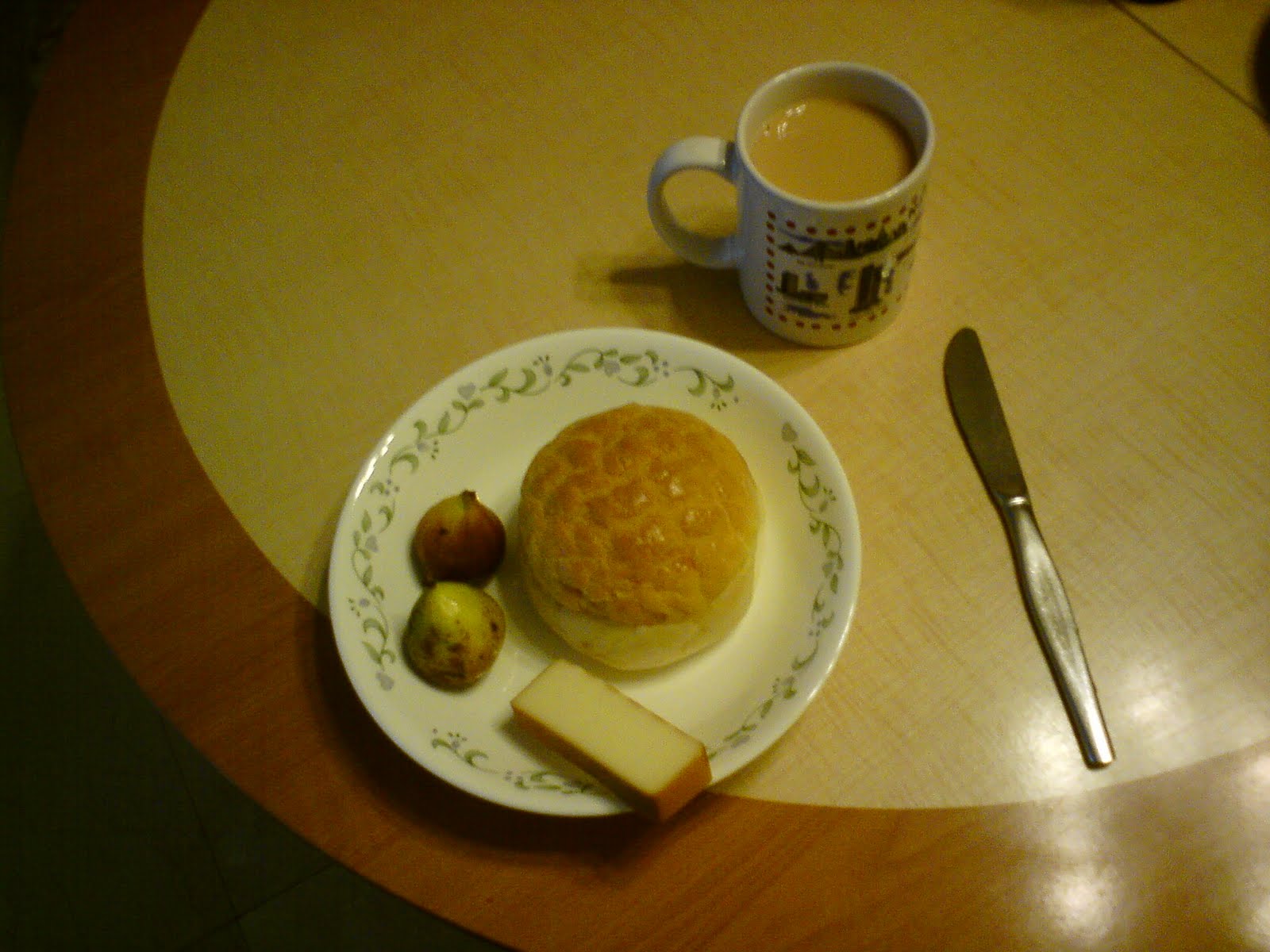
Consequently we took matters in to our own hands. A short stroll to the local Saint Honore Cake Shop provided us with a pineapple bun. From a grocers in Central mysteriously called City Super, we obtained a piece of Bavarian smoked cheese. We were disappointed in the produce of City Super finding it to be almost entirely imported and decidedly overpriced. We received the gift of figs from a Carmelite nun in Stanley, for which we were most grateful. This plain but wholesome meal we found most fortifying particular accompanied as it was by the brewings of the Camelia Sinensis plant.

Wednesday, 18 August 2010

Cafe Soho

John Montagu, 4th Earl of Sandwich, frequently asked his valet to bring him meat tucked between some bread so that he might eat without leaving the gaming table. In the 17th century the area that had formerly been the parks of the Palace of Whitehall came to be known as SoHo after the hunting cry used by the Duke of Monmouth.

In 2003 Cafe Soho was awarded "Innovative Sandwich of the Year" by the British Sandwich Association. We had received enquiries from some of our readers as to where they might locate a ploughman's lunch that their valet might take out so that they need not leave the gaming table.


We sent our valet to Cafe Soho having heard of the innovative things that they had done with dishes served in the manner of the Earl of Sandwich. We were very pleased with the light yet wholesome repast which he returned with. The bread was French but the blame here may lie with our valet. The cheese in one half was mild enough not to detract from the tangy feel of the gherkin. The other half had gently sliced ham the taste of which transported one directly to Wiltshire. This was closely allied with wonderfully flavoursome tomatoes.

Is this really a ploughman's lunch? Perhaps not. We have had our valet soundly beaten for this but the quest for a true ploughman's lunch within a hunting cry of Somerset House and yet without leaving the gaming table continues...

The Rose and Crown, St Albans

Following complaints that our previous review was too brief we'll make sure we go into full detail this time.

The medieval town of St Albans grew up around the Benedictine abbey established at the site of the beheading of Saint Alban in AD 324. Unfortunately the town is little blessed with parking so what first attracted us to this picturesque public house was not its gently aged timber framing, the willow tree gracefully billowing in the gardens or even its close proximity to the river but in fact the space left in the car park.


The ploughman's lunch formed part of an extensive and well thought out menu of bread and cheese based offerings that included sandwiches to suit every taste and every purse. The ploughman's was avaiable with cheddar, stilton, turkey or ham. We felt enboldened enough to choose the robust blue cheese.

What first struck us about this lunch was the perfect bread-to-butter ratio. The foliage was light but extremely varied. Pickles well represented with both dainty onions and a substantial gherkin. A gesture of potato salad provided useful ballast. Pickle was shop-brought but thoughtfully presented.

A small but well-kept selection of real ales was available as accopaniment, though we were obviously obligied to shandify our choice. The meal was completed by some cheerful banter from the chef.